
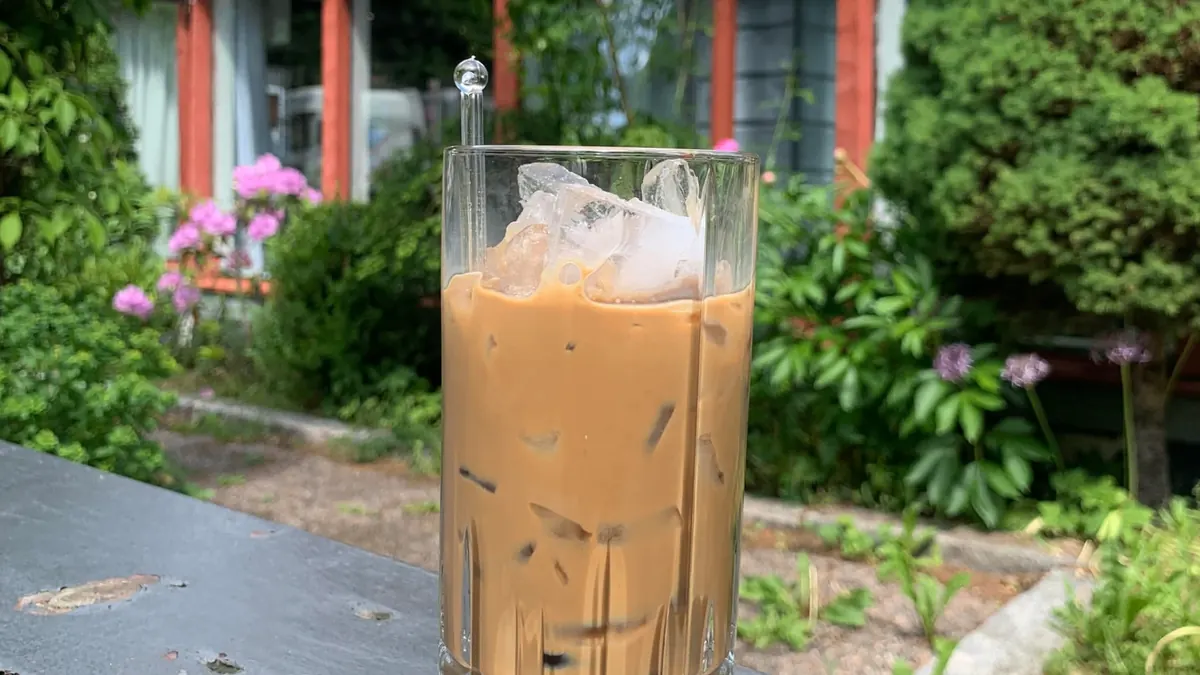
Vietnamese coffee is a bold, dark-roast Robusta brewed in a phin filter and often served with condensed milk. Here's what makes it different.
Vietnamese coffee is a bold, dark-roasted coffee made mostly from Robusta beans, brewed slowly through a small metal filter called a phin, and traditionally served with sweetened condensed milk. It's stronger and less acidic than the Arabica-based coffee most of Sweden grew up on - and that intensity is the whole point.
If you've only ever had a flat white or a bryggkaffe, your first Vietnamese coffee is going to feel like meeting a louder, more confident cousin of the coffee you know. Here's what's actually going on in the cup.
It starts with Robusta, not Arabica
Most specialty coffee in Europe is Arabica, prized for its bright, fruity, sometimes wine-like notes. Vietnam took a different road. It's the world's largest producer of Robusta - a hardier bean with roughly twice the caffeine, lower acidity, and a deep, chocolatey, almost savoury body. Roasted dark, Robusta gives you that thick, bittersweet punch that holds its own against ice and condensed milk without disappearing.
Our coffee is 100% single-origin Robusta from Pleiku, in Vietnam's Central Highlands, roasted in Đà Lạt. We chose Robusta on purpose - not as a cheaper stand-in for Arabica, but because it's the bean that makes Vietnamese coffee taste like Vietnamese coffee.
Then comes the phin
The phin is a small metal drip filter that sits on top of your cup. You add ground coffee, a little hot water to let it bloom, then fill it up and wait. No machine, no pods, no rush - the coffee drips through slowly, one cup at a time, coming out concentrated and full-bodied. It's a ritual more than a routine, and that's a big part of the charm.
And usually, condensed milk
The classic serve is cà phê sữa - coffee poured over a layer of sweetened condensed milk and stirred together. Over ice, it becomes cà phê sữa đá, Vietnam's answer to a hot afternoon. The sweetness rounds off Robusta's bitterness into something dessert-like but still seriously caffeinated. You can absolutely drink it black (cà phê đen) too - it's just a matter of taste.
Why it's having a moment in Sweden
Sweden drinks more coffee per capita than almost anywhere on earth, but Vietnamese coffee has stayed surprisingly hard to find done properly. That's changing - TV4's Nyhetsmorgon recently named it one of the next big coffee trends here. People who discovered it travelling in Southeast Asia, or who grew up with it at home like we did, are looking for the real thing rather than a watered-down version.
That's exactly why we started TRAN Coffee Lab: two sisters from Borås, now in Stockholm, bringing the coffee we grew up with to the country we grew up in.
How to try it yourself
You only really need three things: good Robusta, a phin, and condensed milk. We put all three in one box so you can brew it properly at home from day one - that's our No Regrets Horse kit. If you want to get the technique right, read How to brew Vietnamese coffee with a phin. And if you're wondering why we're so committed to Robusta, here's Robusta vs Arabica.
FAQ
What is Vietnamese coffee?+
Is Vietnamese coffee stronger than regular coffee?+
Do you need a special machine?+
What does Vietnamese coffee taste like?+

Co-founder, TRAN Coffee Lab
Cecilia is the older sister and co-founder who keeps TRAN Coffee Lab running. From the legal paperwork to the accounting, the website, and the logistics - she builds the systems behind the scenes so every bag of coffee makes it to your door on time.