
Vietnam is the world's second-largest coffee exporter

Vietnam is the world's second-largest coffee exporter after Brazil and the top Robusta producer. Here is why, and its main growing regions.
Vietnam is the world's second-largest coffee exporter, behind only Brazil, and the largest producer of Robusta. Robusta makes up about 97% of Vietnam's output, and the country grows roughly 40% of the world's Robusta. The Central Highlands produce more than 90% of it. Vietnam reached this position through an ideal Robusta climate, rapid expansion after the 1986 Đổi Mới reforms, and a focus on high-yield Robusta.
How big Vietnam is in coffee
Vietnam ranks second in the world for both coffee production and export. The USDA forecasts Vietnam will export about 27.9 million 60 kg bags in 2025/26, second only to Brazil. In Robusta specifically, Vietnam leads the world, supplying close to 40% of global Robusta. Most of the instant coffee and espresso blends sold worldwide contain Vietnamese Robusta.
Why Vietnam rose so fast
Vietnam's rise came from climate, reform, and focus. Coffee arrived with French colonialism in 1857, but the surge came after the 1986 Đổi Mới economic reforms, when government policy and private farming expanded planting rapidly across the Central Highlands. The region's altitude, warmth, and rainfall suit Robusta, which is hardy and high-yielding, so Vietnam scaled a large, low-cost, Robusta-focused crop faster than any other country.
Vietnam's coffee regions
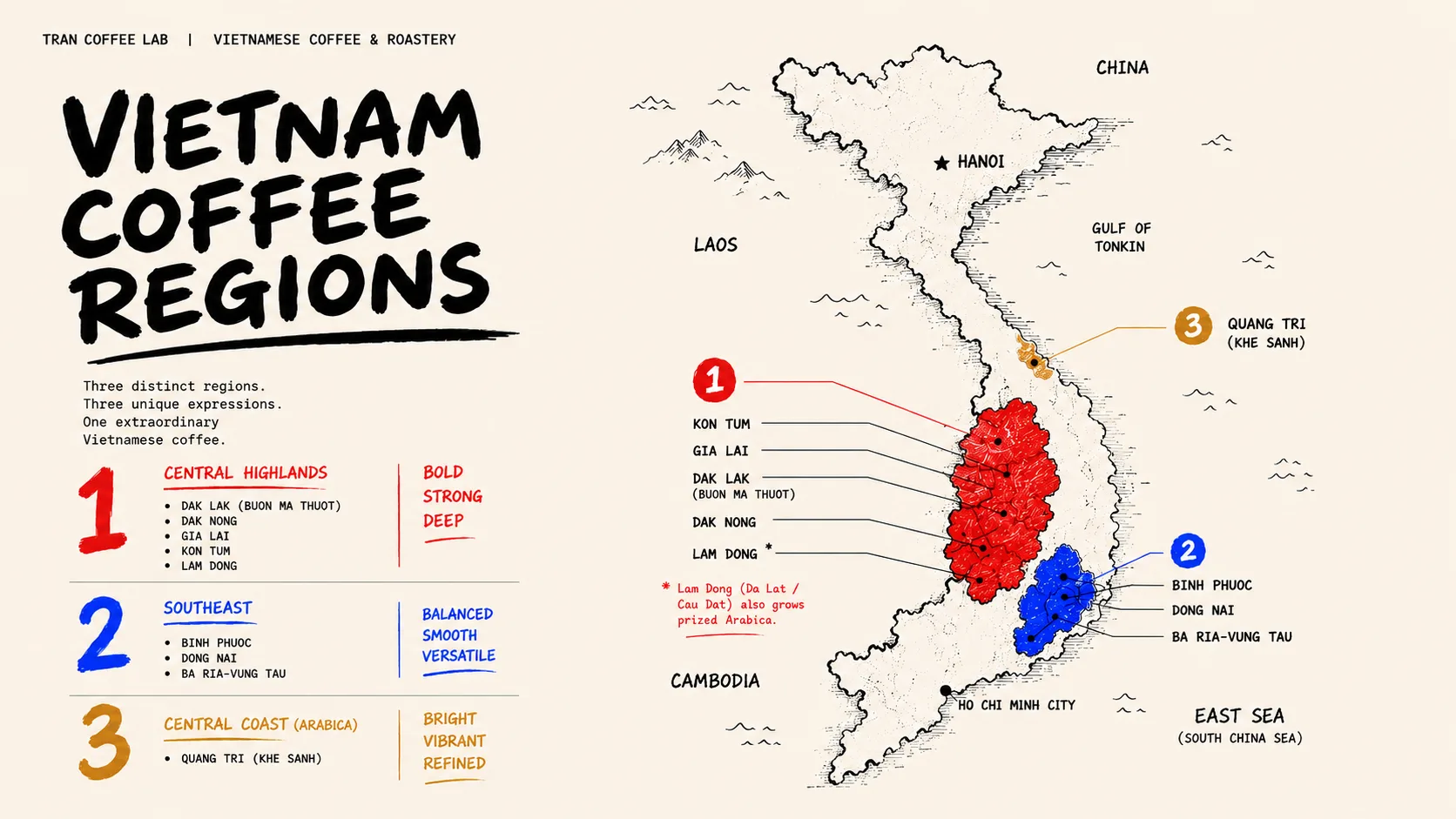
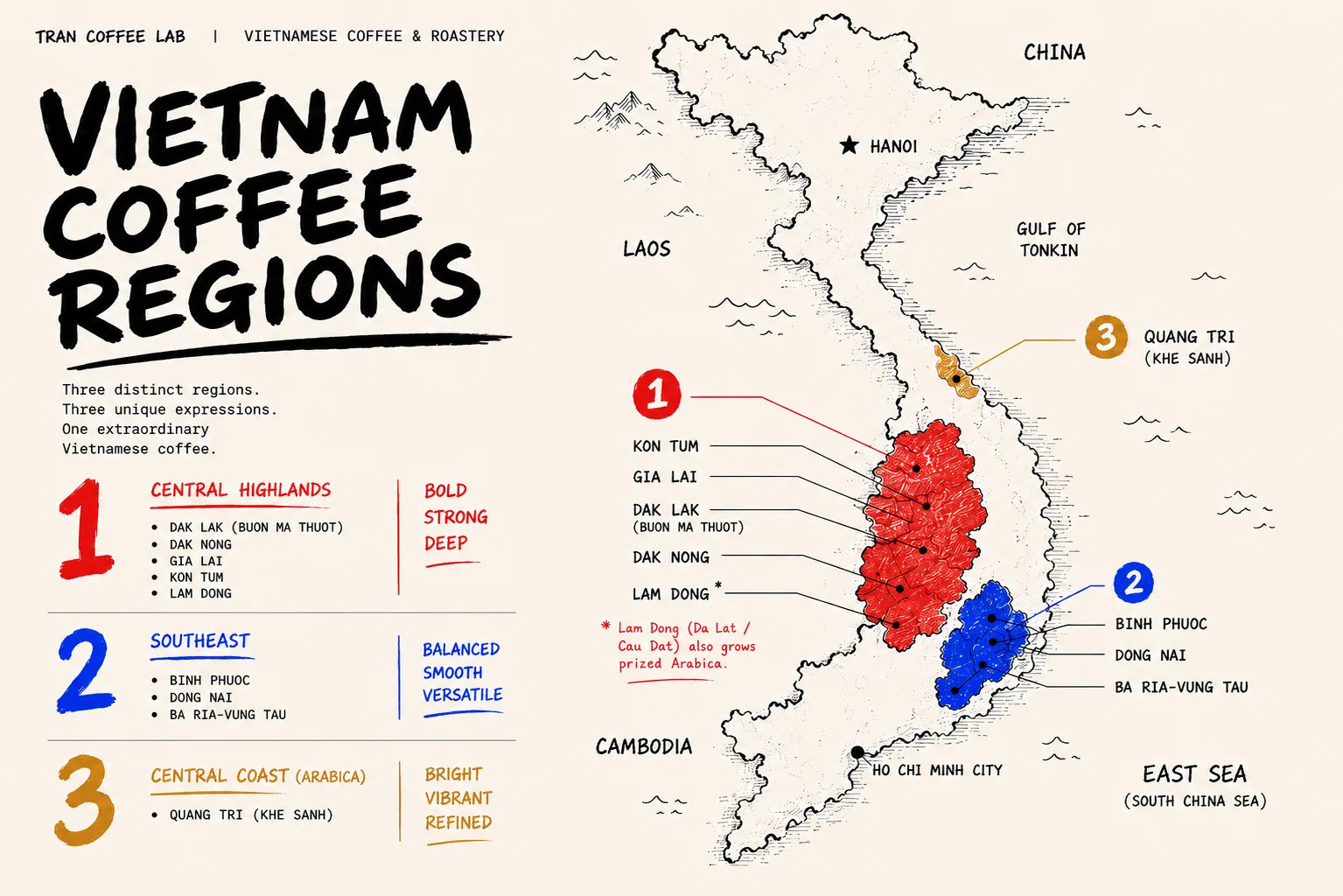
Vietnamese coffee comes mainly from three regions, each with its own character.
1. Central Highlands (Tây Nguyên), bold and strong. This is the heart of Vietnamese coffee and the source of the vast majority of the crop, almost all Robusta. Its five provinces are Đắk Lắk (home to Buôn Ma Thuột, the coffee capital), Đắk Nông, Gia Lai (the area around Pleiku, where our beans grow), Kon Tum, and Lâm Đồng (whose Đà Lạt and Cầu Đất highlands also grow Arabica). Red basalt soil and a cool, wet plateau climate make it ideal Robusta country.
2. Southeast (Đông Nam Bộ), balanced and smooth. The smallest of the main regions, roughly 10 to 15% of output and mostly Robusta, across Bình Phước, Đồng Nai, and Bà Rịa-Vũng Tàu.
3. The central coast and Arabica pockets, bright and refined. Away from the Robusta heartland, Arabica grows in cooler, higher spots: along the central coast in Quảng Trị (Khe Sanh) and Nghệ An, and in the northern highlands of Sơn La and Điện Biên. These cups are lighter and more aromatic, though Arabica is only about 3% of national output.
Where our coffee fits in
Our coffee comes from the heart of this map. TRAN Coffee Lab uses single-origin Robusta grown in Pleiku, in Gia Lai province, and roasted in Đà Lạt in Lâm Đồng, sourced through Bui Coffee Supply. Read more in Single-origin Robusta from Pleiku and on our supplier page.
Who is number one
Brazil is the world's largest coffee producer and exporter. It grows roughly a third of all coffee, mostly Arabica plus some Robusta (known locally as Conilon), across large plantations. Vietnam sits second overall but first in Robusta, which is the difference that defines its coffee. See why that bean matters in Robusta vs Arabica, and how it all reaches the cup in How coffee is made.
FAQ
Is Vietnam the largest coffee producer in the world?+
Which country exports the most coffee?+
Why does Vietnam grow so much coffee?+
Where is coffee grown in Vietnam?+
Does Vietnam grow Arabica too?+
Co-founder, TRAN Coffee Lab
Cecilia is the older sister and co-founder who keeps TRAN Coffee Lab running. From the legal paperwork to the accounting, the website, and the logistics - she builds the systems behind the scenes so every bag of coffee makes it to your door on time.